

What works beneath the surface

I don’t recall noticing the small shifts of light in this latitude growing up, but after living in the north, where each degree farther makes a difference, perhaps I’ve become more aware of when the light shifts. Walking in the woods this week, I noticed the light has changed. How is hard to describe, but as if on cue, a day later M says to me offhand, the light has shifted, did you notice?
In other years, living in Anchorage, that shift of light towards August would be a harbinger of fall—typically the birch would start to turn yellow two weeks later, rains would come, and the air would start to have a stronger chill. Here I thought about what it foretells—more heat, still warm nights, the smell of dry grass and blackberries heating in the sun. There is yet much more summer to come here.
I’ve been walking in the woods for small walks with the dog, taking time to admire the green canopy. How a small breeze shifts the light filtering through young maples. Swallowtail butterflies, appearing in full sun, then secreting back into shade, flying higher in pairs among the leaves. In a journal I’ve been neglecting I write: Walking in the green light of maples on a hot day—the world feels mad and distracting—but perhaps not to the butterflies winging through the forest, leaves mimicking their flight in the breeze.
The next morning I realize I dreamt of being asked to sign my name in a sort of ritual, fountain pen ink on the wing of a butterfly and wasn’t sure I could go through with it, asking what harm would come to the wing?

Butterfly wings are made of dust—scales of ephemeral substance that overlap like shingles across the chitin scaffold of the wings. It feels more like fairy dust to me. So impossibly fragile, with color that shines and refracts across distances, completely disintegrating with our touch. When I lived in Norway, I learned the Norwegian word for butterfly literally translates to summer bird. I always loved how it sounds—sommerfugl, like a funnel of summer, an iridescent whir circling in the breeze.
I’ve been composing poems and lines in my head, but I’m still unsure of whether they’re ready to be a poem or a line of prose yet. Wondering about their relevance in a world of weight and chaos, something so lightly dusted, flying in thought. Writing can sometimes feel like a current, something that takes over and is necessary. Other times, it is metamorphosis, taking time and still emerging in a fragile, fleeting state, not ready to be pinned down in ink.

At a recent routine doctor’s visit, I fill in the different intake forms they have you do at each checkup for medical history, mental health and begin to laugh a bit darkly at questions like “have you felt despair in the last week?” with options of never, several days, most of the time, always. How in the world to answer in such a time? Yes, but I’m not about to kick off or anything. But yes, I feel despair, anxiety, concern, desperation every day, I’m not sure how one doesn’t with all that is suffering right now, of how willing and gleefully cruelty is being inflicted on others. How little justice there really is. How to be a witness to all of this and not spiral.
I go to the woods each day because I can tell my attention is fleeting, distracted, horrified, despairing. Like my friend
wrote so beautifully last week, I keep trying to pay attention to what is in front of us, to find some way to move through the world that doesn’t dull us from attention to what is nearby, and of what still can bring joy.So I try to offer attention to small things, close in front of me—the taste of real fruit again in season, something I had missed for so long living in the north—raspberries from nearby that overflow with the taste of summer and remind me of my grandmother’s garden and the jam she loved to make for us long ago. The taste of strawberries that seem a wonder in each bite. The wings of a butterfly in flight at the tops of maples, cedar, made of a dust that reflects only brilliance.



The summer of the pandemic I collected and pressed flowers from along the pond walk I would take each day in Anchorage. I looked at them the other day, thinking about life at that time, those flowers accompanying us while the world stopped. How bright and jewel like they seemed while the world felt so bleak.
I’ve collected plants here as well as we moved into this new home a few months ago, wanting to mark the occasion. And realize that they will also mark a time when the world shifted, will become memories of a time when the world felt it was descending back into its worst histories. Different snapshots of beauty in times of despair.


Looking again these flowers still bright from five years ago amid so many changes reminded me of Hilma af Klint’s stunning study and illustration of plants. About these studies, Af Klint wrote: “When we turn our gaze toward the plant kingdom, it gives us information about the composition of our own being.”
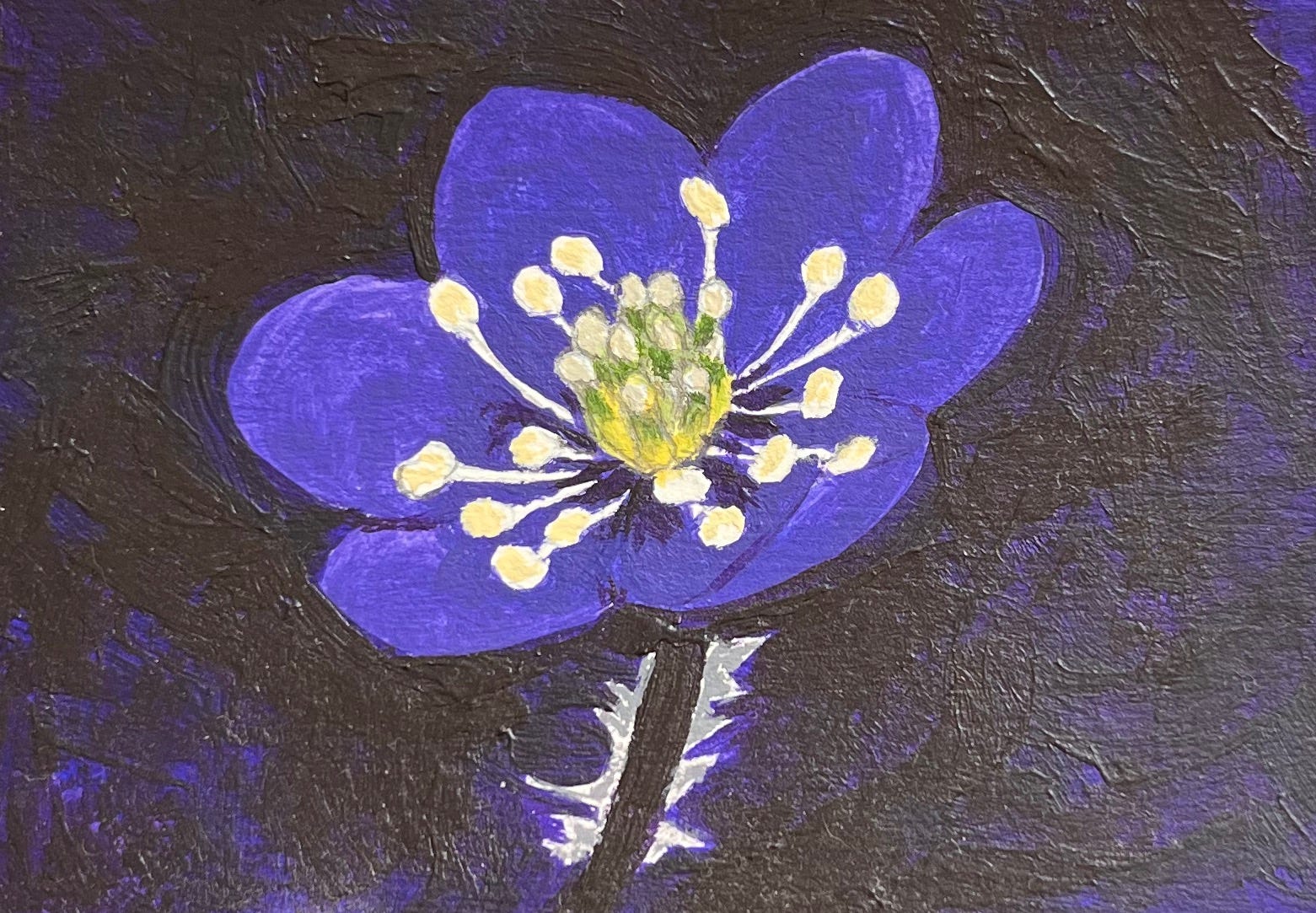
With each botanical painting, she sought to find the inner correspondence to its—and ours—souls’ meaning. In April 1919 she wrote: “The charming little Anemone hepatica has been selected as a starting point in this book. It points to the results of its work beneath the surface when in faithful confidence in the sun’s rays it opens its bright-blue sheath and bonds with the spring breeze.”
M painted a small, single hepatica for me when we lived in Norway, the first flower to arrive in those high latitudes that we learned to look for among the overwintered mulch in the early spring woods. Next to Af Klint’s hepatica she wrote: “The character of the blue hepatica: Joy.”
Her illustration below the hepatica is the catkins of a filbert, a plant that also returns to life in the early northern spring. Of it she writes: “The catkins tell us that our life force must be exerted at the right time. With its insignificance and its coloring, the part that receives the pollen wants to remind us that a desire to be inconspicuous, unimpressive, can be only natural for anyone capable of receiving sublime thoughts.”
I love these ways of seeing, thinking about the deep study of one plant. To be inconspicuous and find sublimity. To seek what else might wait in faithful confidence of the sun’s rays. To look at everything with close attention, to find what speaks beneath the surface.
How much we neglect or block with our attention and focus growing thinner. How radical small—inconspicuous, unimpressive—attention feels when the world we’re told is happening around us is so loud, demanding, ego hungry. af Klint knew that the way out of the shallows of life was deep attention to what is close, to the world around us that is too easily dismissed as insignificant.

So I write down notes of the plants, of seeing dusted wings because this is what feel significant to the routine of daily life right now, as much as what we are bearing witness to elsewhere. To notice how the plants are shifting with the seasons alongside us. To notice the light has changed with the move of the earth, that wings and leaves in slanting sun whisper to one another and know—that there is metamorphosis, bodies that change into wind, seed, soil, light. To not let go of a world that speaks in a different type of attention—one that comes closer to something like prayer.
Freya, this piece is a total reclamation of attention. Thank you for your incisive wisdom. You carry the ability to bring back your readers focus into the importance of real and ephemeral beauty of the world. I can breathe loudly when you write. Thank you 🙏 💜
After much shifting of my own, what a breath, a wonder, a delight, to read this among "catching up" in my inbox -- which I put into quotation marks because your writing reminds me of what I want to be doing, resting and tending/attending, not catching anything at all.
And I read it immediately after one of Elif Shafak's in which she wrote, "For art to survive and thrive, all we have to do is simply and faithfully honour a feeling, a connection, a moment in time. There is no cleverness there. Perhaps the very opposite, only foolishness.
No complicated goals either. Only love."