

A chain of creating

In graduate school I did field research in the northeast of Scotland. It was early spring, still cold, sun breaking through sea winds as I walked where an early medieval Pictish settlement had once stood. In the ruins of a broch—round towers of dry stone that stood tall in the northern Scottish landscape long before vikings arrived— I laid down on the long grass, shiny in the sun, at the center of the ruin. In that circle of drystone stacked walls that now only reach about five feet high, the wind instantly stopped, still buffeted by the stone walls. I was struck to feel a shelter that had been felt by those who lived there over a millennium ago—to share an experience across time in the same place. It felt like the ghosts of so many centuries of lives and wind in one place who had created that shelter were suddenly whispering see?
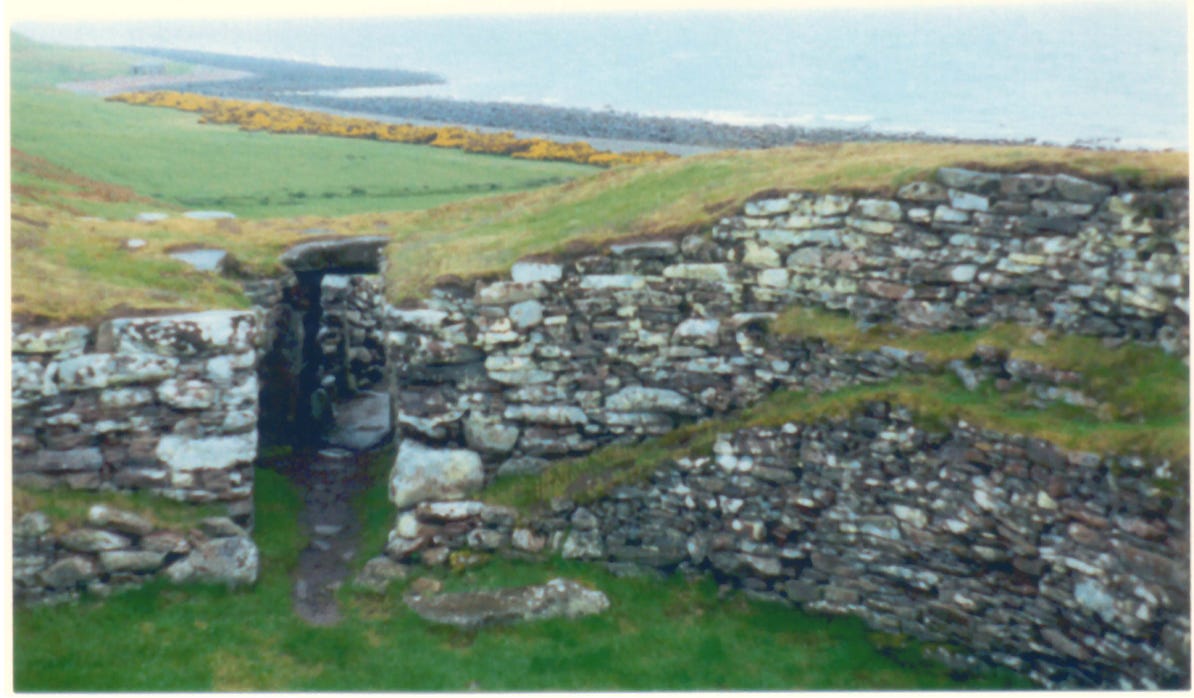
As I think of that unforgettable, yet rather unassuming experience at the broch, it did in fact feel like the vertical was meeting me, as I was within that ruin. Something eternal and of the moment at the same time.

I’ve been reading a book that looks at the dwindling arts and trades that used to be done by generations of the same family, such as the building of drystone walls in England, Scotland, or the thatchers of roofs. Pre-industrial work that was based on an understanding of the land and what it offered and how it could be used to fashion a life.
I was struck by the remark of one of the remaining living stone wall builders:
In years to come…I’ll be forgotten and anonymous just like the people who came before me. The only thing I care about is making something that will still stand in the landscape after I’m gone. That’s all the credit I need.’”
The writer goes on to say, “Many wallers are motivated by a desire to contribute to something larger than themselves, to become a small but essential link in a long chain of creation.”1
I don’t want to make a mark on the landscape after I’m gone, but I do want to make things that contribute to the chain of making, creating. Something that is not of me per se, but that I was just one more part of the wider making.

There are so many scattered thoughts, scattered attention, scatters of horror that arise throughout the day. How to keep a narrow focus feels harder and harder of late. I find myself wanting to make with my hands more than I ever can remember. I’ve always begun anything written on the page with a pen moving across, but now it feels more necessary.
Over the last year I taught myself to knit—rather poorly—and despite the mistakes, I keep reaching for it as well, to steady with the trance like motion in the repeating pattern of stitches. This weekend I began knitting a red hat, after learning from my friend Anna Brones that red hats were a sign of resistance during the German occupation of Norway.
When I lived in Norway, that memory of the occupation felt incredibly present2. We lived in a large old house that was first built to house children with tuberculosis and then became an orphanage, and then was occupied by German soldiers during WWII. Barbwire was still in place at the top of the hill behind the house. A German soldier’s cross-medal was unearthed during spring planting of the garden. So much barely below the surface of time. Learning that history in place was a clap of reckoning in understanding how recent it all was.
I became a bit obsessed with the Norwegian resistance after living there—of learning about the resistance networks, of the women who led spy networks—and also of those Norwegians who didn’t. In the area of Trondheim where we lived, there was a man who betrayed his neighbors and worked for German intelligence, whose cruelty became well-known—I can still remember finding the historic photo of him with a bruised and battered face when he was finally arrested after the war. I hadn’t learned of the red hat campaigns, though, until my own country is being occupied by its own tyrants.
I don’t have any delusions that knitting a hat is going to make any of what’s happening better. But it does make me feel some connection with the past that is echoing yet again, rising in a circularity that tells us to finally stop believing in linearity, progress. And to pay attention to what is in front of us. We witness, we write, and as Anna wrote about so beautifully this weekend—we need to create in such times. To be a part of a chain of creation, in opposition to destruction.

It’s that long chain of creation that I’m thinking of these days—to make and be a part of that chain, of what is larger. To knit in solidarity with women from the past who kept their family warm by making clothes, to those who kept the tradition alive when we no longer needed to (as a rule). To knit in solidarity with those from the past and now who don’t accept the cruelty we’re being told is justified. To write poems on the page, words on a page, think with hands and without the suggestion of a grammatical/spelling/ai changing or filling a line in before a thought is even finished. To be in conversation with others through writing—readers now, as well as writers from the past. To tend to the lands we now live on and make sure there is food for the birds, sugarwater for the hummingbirds, plans for spring planting.
To notice when we can give and receive moments of shelter—moments that connect us to the vertical more than the horizontal.
Fox, James. 2025. Craftland: In Search of Lost Arts and Disappearing Trades. Crown, New York. P. 35
I’ve written about that history here in detail.
Loved your words and the idea of belonging to the chain of creation. We all must stand up now to the evil and write and create art.
(Trondheim is where my mother's family came from. )
Thank you for this wonderful reminder of that feeling of temporal depth, of connecting to those who came before us through the stones they laid and left in the landscape and the craft skills we inherit.