

Winter is wept
come spring
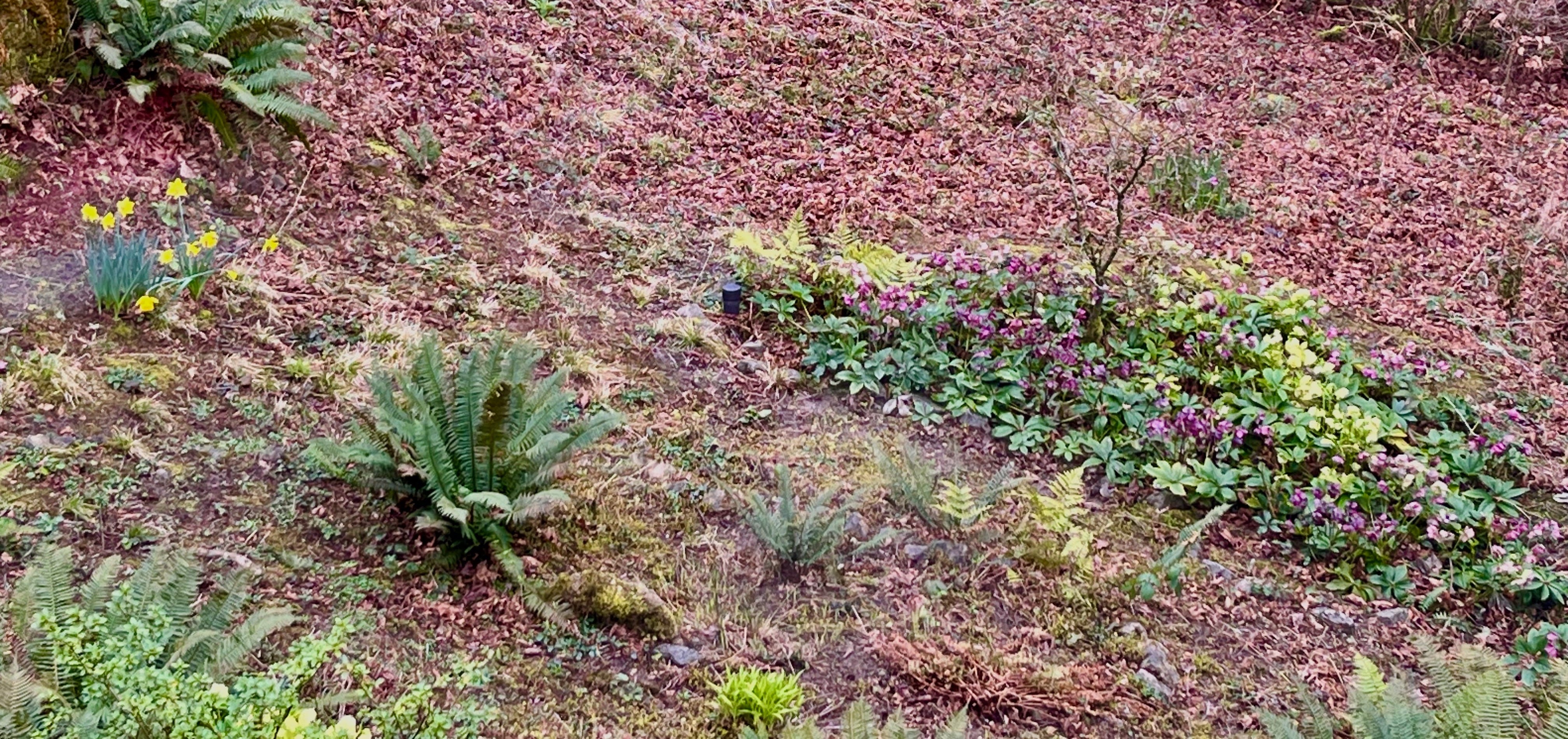
The hellebores are thriving among the dead—the leaves from last summer at their feet as they bloom in the mild chill of February into March.
Daffodils have followed, bright crowds of yolks on blades of newly green that whisper wordsworth in my mind—they know they are indeed worthy of words.
The meaning of spring is still a calibration in my mind, after so many years living at a high latitude. Temperate is not a part of spring in the north. March means the cold is still strong but the light becomes relentless, daylight savings a horror—the week prior, the light and dark were finally, nearly equal and we could wake in daylight after months, but still enjoy the quiet of a night accompanied by darkness. March meant the jar of having to once again wake in the dark, but the light reaching past 8pm, reflected snowlight becoming more and more stark as ploughed banks aged into spring ice, thawed and frozen in repeating cycles each night. Spring in the far north is a draining of color—announced by the call of gulls returning, their grey and white bodies seamlessly matching a landscape of gravel, thaw, and melt. Geese and a few swans begin to arrive in April, a kind of assurance that there is news of spring further south. And so we would wait for late May, dreaming of the color green moving north.

Here, back in the Pacific Northwest, where I was born after living elsewhere for so many years, I’m reminded that spring can be mild, unurgent. The slow rhythms of first leaves—umlaria, cherry blooms, hawthorn. Hellebore, daffodil, and soon trillium. Bird song shifts subtly, adding new notes to their calls.
We drove out to Sauvie’s Island—a place of flooded fields and waterways that remains rural with some luck of foresight in the mid-twentieth century (and funding). We walked the beach of the Wimahl/Nch’i-Wàna (the Columbia River) and were alarmed to find dozens of smelt—hooligan1 beached on the shores. These small smelt tumbled in the small wake from passsing boats and we wondered aloud if it was algae blooms, but it seemed too cool, early for that kind of event. We later read that they have spawned and like salmon, die soon after.
Two sea lions emerged from the surface of the river, and we could hear their sharp exhales as they dived—feasting on spawning smelt perhaps, but more likely the salmon that have also begun to run. They too arrive earlier at this latitude than in the north. Watching it all, I’m reminded that the new growth and life of spring is accompanied by death and a return to the earth— not two separate ends, but part of one another.
We later stopped to watch thousands of snow geese, canada geese, sandhill cranes, tundra swans, canvas back ducks, shovelers, egrets congregate in a rain-emergent lake. Sand hill cranes—whose call is one of the most prehistoric and beautifully weird, like a rattle of fog, reed, and water—were often heard outside our Anchorage house in the nearby marsh in summer. To hear them again here, with the geese and swans readying to head north felt like a twin familiarity, two homes reflected in the other.
As I watched, I heard in my mind one of the first poems I had written and forgotten about, the last stanza arriving as easily unbidden as it did when it first arrived on the page:
…while the lake dark with geese wings catches
bleeds onto the green beneath hiding and winter
is wept
come spring

from the archive—a meditation on what spring looks like in the north.
These small fish—eulachon, candlefish, hooligan, smelt—are a significant resource across the Columbia River and the PNW into Alaska, and some research into the name hints that the name for Oregon derives from hooligan.
I’ve never lived that far north (I’m currently in VA), but I found daylight savings jarring for the same reasons this week. I miss waking up to sunrise and don’t like having it still be so bright when I’d rather start slowing down for the day.
Two springs, eloquent and evocative. Thanks Freya. ‘a rattle of fog, reed, and water’ is wonderful.